
If are you living in Canada, especially in major cities like Toronto, Vancouver, or Montreal, then you have witnessed a housing bubble, a dramatic increase in housing prices in 2021 with a peak at the beginning of 2022. The prices jumped so high to the point that you could see an average increase of %30 in Greater Toronto Area prices alone. Everyone knew that at these unreal prices, at some point, the correction starts and prices will adjust and decrease.
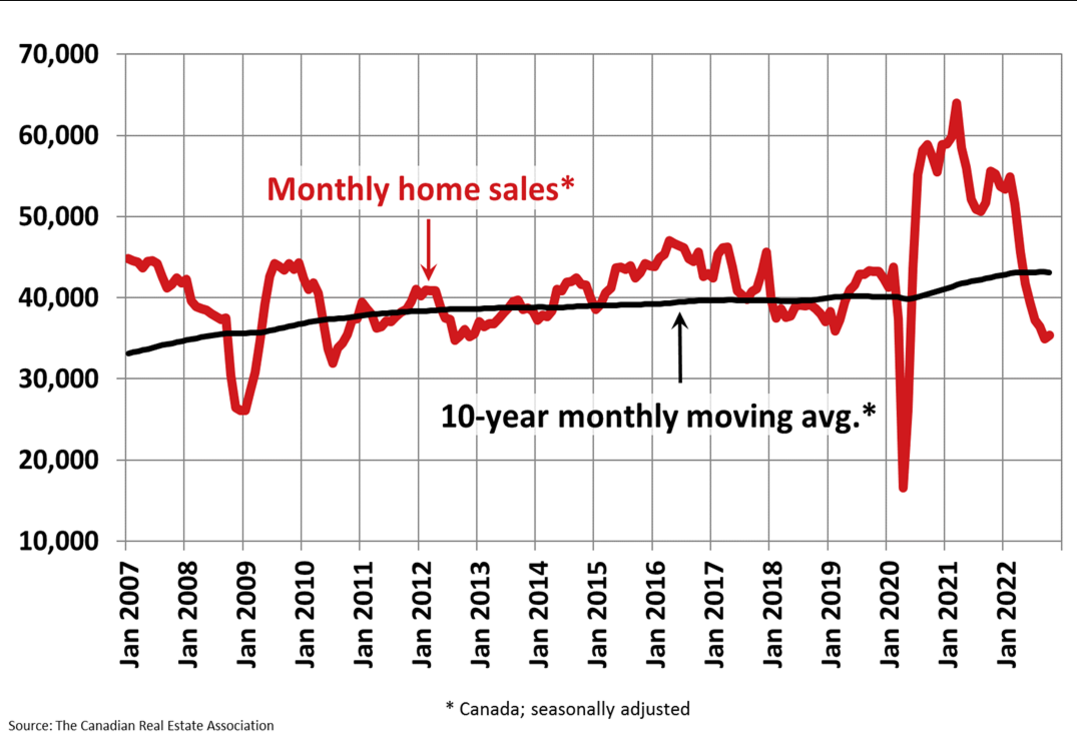
The increase in the Bank of Canada’s interest rate, which was expected from economists’ view, halted the growth of housing prices and pushed housing prices to enter the land of correction. This move was hugely unexpected by Canadians; after all, they trusted the bank of Canada’s promise that: “there will be no rate hikes until the end of 2023”. The hasty increase of rates starting from March 2022 led to the overnight rate of 3.75% in under 8 months slowing the monthly home sales to levels below the 10-year monthly moving average.
On December 7th, 2022, the bank of Canada once again raised the rate by another 50 points to 4.25%, pressing hard on the break to slow the inflation seen in 20223.
The question we all are looking to answer is: Is the housing bubble bursting? Are the housing prices declining dramatically because of the rates? Will Canada is the highest number of property foreclosures in its history? To understand and even attempt to predict the housing market in the next few years, we need to examine the elements that are critical to the housing market in Canada.
The importance of housing in Canada
Canada’s economy is intertwined with the housing sector in many ways. Investment in residential properties alone has reached just over 10% of Canada’s GDP, the highest in the G-7 countries and almost double in shares compared to our closest counterpart, the United States which indicates only 4.7% of their nominal GDP. You might ask why is this important.
Well, housing is not just about construction, renovation, and the jobs in between; don’t forget the ownership transfer costs which include land transfer taxes, transactional costs, and of course the fees of your friendly realtor. This piece alone accounts for 27% of the GDP contributed through residential housing. Therefore, even if construction and renovation come to a halt, the sheer presence of residential housing transactions can still come to the aid of Canada’s economy.
Therefore, the federal government threads carefully to ensure the number of residential real estate transactions do not significantly drop to prevent the drop in the GDP. However, currently, the number of transactions has fallen below the 10-year moving average and if this continues, it will create pressure on the feds to adjust and lower the rates in an effort to stimulate more transactions.
But, there are other factors to consider before we draw a conclusion.
How will the interest rate hikes really affect the prices?
As you have seen in the past eight months, as the interest rate increases, the cost of owning a home and borrowing money increases, and therefore less number of individuals will be able to afford mortgage payments. In turn, the demand for purchasing a home will decline and this will automatically drive the prices down. Sounds simple right? You need to look at the real situation of Canada more closely.
To really understand the impact of mortgage rates on the housing sector, we need to examine how these rates will impact the buyers now compared to individuals who already purchased 6 months, one year, and two years ago. Keep in mind that your mortgage needs to be renewed every five (5) years and the increase in the mortgage rate will mean that as early as three years, homeowners will be faced with increased costs of home ownership.
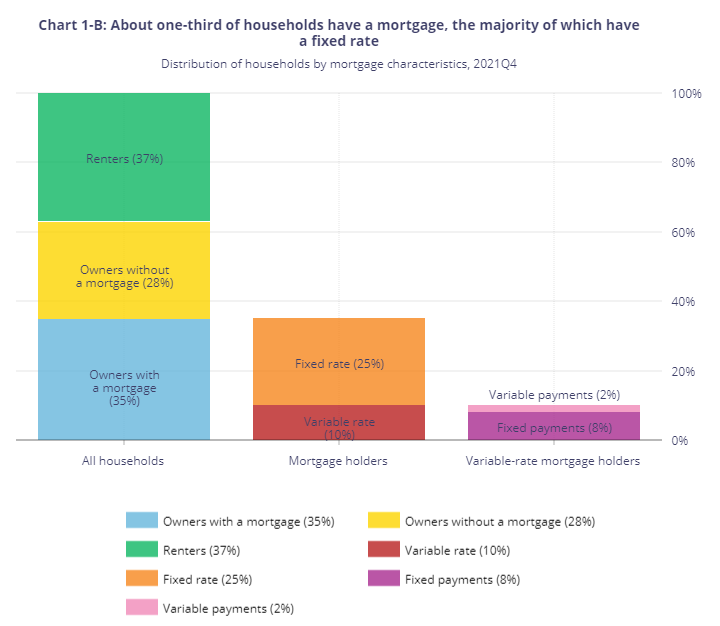
It is critical to understand how Canadians are paying for housing in 2022 to understand the impact of rate hikes on the current and future affordability of housing. Only %35 of households have a mortgage balance; out of this, 72% of them have fixed mortgage payments. This means that they will not be affected by the rate hikes for at least three more years and their mortgage payments will remain the same. What about the remaining 28% of mortgage payors?
This is where you need to pay attention. 22.4% of the remaining payors have fixed payment variable mortgage rates. As the name suggests, the monthly mortgage payment does not change even as the Bank of Canada rates are increased; however, the portions of the payment that is allocated to pay the principal loan decreases. This means after the five-year term is completed, more of the payment has been used to pay the interest portion of the loan rather than the balance. While this is not a favourable situation, the short-term upside is that the monthly mortgage payment remains the same.
The remaining 5.6% of the mortgage payors will experience an increase in their mortgage payment with every rate hike. The risk for this category of mortgage payors is that their payment will become so high that they can no longer afford to pay and they will be forced to put the property up for sale.
Considering the most recent rate hike on December 7th, and in general increased cost of living due to inflation, increases the likelihood that the Canadians who have variable payments will put their properties for sale. The increase in the number of properties in the market along with the high cost of borrowing will create a downward push on housing prices.
However, this will only be the case with 2% of all households across Canada, and even if a huge portion of these households decide to sell their properties, it will not be enough pressure to drive the prices down significantly.
The relationship between immigration and housing
It is no secret that immigration is one of the most important industries in Canada and an asset to the Canadian economy. From 2016-2021, immigrants made up 4/5 of the labour force growth (Statistics Canada). Immigrants are selected for their ability to contribute to the Canadian economy due to their past work experience and education. Examining the percentage of Canadians who hold post-secondary degrees, over %70 is comprised of immigrants who either studied in or outside of Canada.

Having a post-secondary degree increases the likelihood of immigrants finding employment and generating income. In fact, 73% of the foreign-born population in Canada is employed which is even about 1% higher than our neighbouring United States.
What is the connection between having educated immigrants who have meaningful employment to the housing market? Well, not surprisingly, 65% of immigrants and foreign-born population in Canada are homeowners. According to Ipsos online survey, 49% of immigrants in the Toronto region were able to purchase their first residential property within 5 years of landing in Canada. Immigrants bring their financial assets from their home countries and have employment income to afford the mortgage payment; hence the high percentage of home ownership.
Now consider the extensive plan of the Canadian Government to welcome more immigrants to the country to make up for the lost immigration during the pandemic. Canada aims to welcome 465,000 new permanent residents in 2023, 485,000 in 2024, and 500,000 in 2025. (Government of Canada) This is a total of 1.45 million immigrants in Canada within only three (3) years.
Given the current rate of residential housing construction and the housing needs of the existing population and future immigrants and the fact that the newly immigrated population purchases their residential property within the first 5-10 years of landing in Canada, there is a relatively strong upward force on the housing prices that could prevent the decline of the prices at the least, if not, maybe even increase the prices.
We are not in a housing bubble
If you were to ask this question back on February 2022, you would have received a different answer. February 2022 set the highest record for the values of housing with prices jumping over 30% in some regions just compared to the previous year. However, after February with the consistent increase in the Bank of Canada’s rate, the prices started to decline to the point that in September 2022 the average prices recorded were below September 2021.

The prices continued to adjust after September to below 2021 levels but still higher than in 2020. Since the average values on November 2022 are still over 10% higher than the 2020 values and considering the inflation that was experienced since 2020, we can qualify the housing prices as frothy if we are very strict but we can certainly not categorize them as housing bubbles anymore.
What to expect in 2023?
To understand how 2023 will pan out for housing prices, we need to consider the effects of the Bank of Canada rate hikes, immigration policies, inflation control measures, and the unemployment rate altogether.
It is unlikely that the Bank of Canada will be able to return the inflation to the below 3% level until midway through 2024. This means that the Bank of Canada might be inclined to do another round of rate hikes in 2023 to eventually set the Bank of Canada rate to 4.75 % – 5.00 %.
This increase in rate hikes will create a stagflationary economic environment borderline an economic recession. Low household and business confidence along with a moderate increase in layoffs and unemployment will be expected. What happens to the housing market? More individuals will be forced into selling their property while fewer buyers exist in the market, which results in driving the prices of the housing market down.
The last piece to bring into the equation is the parallel increase in immigration numbers. Immigrants arriving in Canada will create a resistive force to the declining housing prices and aid in stabilizing the market.
Taking all into consideration, we predict that in 2023, the Canadian housing market will experience a decline but nothing significant; at worst some areas might experience a decline of 10% – 15% compared to 2021 prices. We don’t anticipate the prices to decline to the point of wiping out all the gains since 2019.